
CHS PreCalc/Trig students
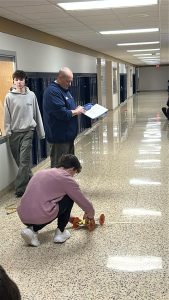
On January 7, 2026, Mr. Oestreich’s CHS PreCalc/Trig students tested MouseTrap cars that they constructed. The students were challenged to build a car that travels 30 feet, only using a single mousetrap to power it.
The project serves as a fun way for students apply what they have learned so far in the class.
The other stipulation was that the wheels could not be constructed from anything intended as wheels. Other than that, students were given free rein in the other materials they used and how they designed and constructed their car.
“I thought it was a really cool hands-on project that still applied to what we learned in class. It was also nice to do a project outside of class that was very self-governed,” said Alex Barrett, whose car went the furthest. Fellow classmate Ben McBride worked on the class-winning car with Barrett that traveled over 80 feet and almost 3 times the required distance.
“I enjoyed how we were allowed to design whatever we wanted, and the guidelines to what we had to build were very freeing. I also liked Mr. Oestriech’s encouragement to build a car with elements that were never or rarely before used in past mousetrap cars,” said Karma Arsenault.
The cars were tested in the hallway during class periods, where the cars’ speeds and distances were recorded. Each car was given two different attempts. The better of the two attempts was taken as the final result.

The results were then used to make three different calculations that students had learned in class earlier this year. Students calculated the Angular Speed of each tire, the revolutions per second (number of times the tire spun per second), and the speed of the car in Miles per Hour.
To document the construction process, students also created a portfolio. The portfolio included pictures and videos of the choices and changes students made, as well as failures they experienced throughout the building process.
Learning how to deal with those failures and make adjustments was one of the most difficult parts of the students’ construction process.
“I want students to experience working something through from beginning to end where you have failure, and then hopefully improvement, and then at the end success,” said Oestreich.
“I learned a variety of different things like how the length of the lever arm and the placement of the mousetrap was directly connected to the distance it travels,” said Jocelyn Cao.
“I learned that sometimes creative solutions are required for things to really work well, and that constant testing is important,” said Claire Sherman.
There were three different opportunities for bonus points: Longest Distance, Fastest Speed, and Best in Show.
The car that went the longest distance was Alex Barrett and Ben McBride’s. The car that went the fastest speed was Connor Weismann’s. The best in show car was a tie between Charlie Closson and Braden Bryner’s car and Carsten Black and Coleton Klipa’s.
“The project hasn’t changed as much as I’ve changed the outcomes. We originally did it just for a distance, but we also now do it with speed as well as for best in show,” said Oestreich.